

You cannot prove that someone likes you from texts alone. The strongest visible signals are reciprocal effort, genuine questions, consistent warmth and movement toward a call or real plan. Read them as a pattern across time, not as a checklist where one fast reply or flirty emoji settles the question.
Reciprocal effort is the clearest starting point
Notice whether both people begin conversations, ask questions and introduce new topics. Interest does not require a perfect 50/50 split, but the exchange should not collapse every time you stop carrying it. A person may be shy or busy; over time, they still find a way to participate if the connection matters to them.
Message length is only useful against the person’s normal style. A concise texter may show interest through reliable replies, remembered details or invitations. Someone who writes paragraphs to everyone may sound intense without offering any real commitment.
Curiosity looks different from polite replying
A polite reply answers what you asked. Curiosity adds something: a follow-up question, a remembered detail or a topic they think you would enjoy. Look for whether they make it easier for the conversation to continue rather than simply responding until it ends.
Warm words can be sincere, friendly or habitual. Compare words with behavior. If someone says they miss you but repeatedly avoids a reasonable plan, the plan tells you more. If they cannot meet but suggest another day, that is stronger evidence of effort.
- They sometimes reach out without needing a favor.
- They respond to the substance of what you said.
- They remember details and return to them later.
- They make or accept specific plans, or propose an alternative.
Consistency beats speed
Fast replies feel reassuring, but they are heavily shaped by schedule and phone habits. A steadier signal is whether the person returns, acknowledges delays and maintains roughly the same level of care. One exciting evening followed by weeks of ambiguity is weaker evidence than moderate but reliable contact.
Be careful with rules about waiting a certain number of minutes or sending a fixed number of words. Those rules reward performance. You are looking for a pattern where both people can communicate without constant guessing or punishment.
Use chat analysis to compare patterns, not predict attraction
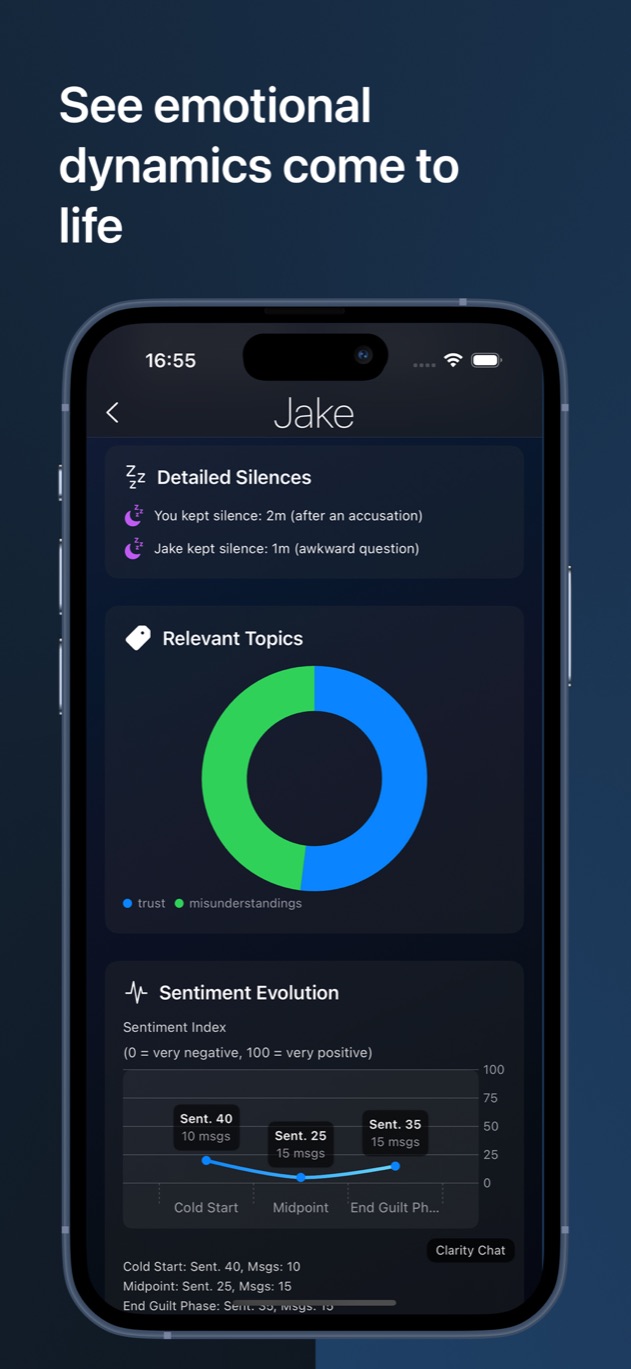
Clarity Chat can highlight interest, curiosity, coldness, avoidance, message balance and changes in sentiment within selected screenshots. Use that structure to compare days or notice where your uncertainty began. The tool cannot distinguish romantic interest from friendship with certainty.
Choose screenshots from more than one moment. Include ordinary conversation, not only flirting or conflict. If the report shows warmth but the wider relationship remains unclear, let that uncertainty stay visible instead of forcing a yes or no answer.
The direct test is a clear, low-pressure step
When it feels safe, offer something specific: a coffee, a call or a date with room to decline. A clear yes, a thoughtful alternative or an honest no gives you more information than another hour of decoding punctuation.
If you are not ready to ask, observe reciprocity without staging a test. Do not disappear to provoke a reaction or send jealousy bait. Give the connection a fair chance to show itself, while keeping your time and self-respect in the equation.
Questions about this guide
Do fast replies mean someone likes me?
Fast replies can show availability or enthusiasm, but they are not proof. Consistent effort, curiosity and follow-through across time are stronger signals.
Can Clarity Chat give me a compatibility score?
Clarity Chat analyzes the selected conversation rather than proving compatibility. Use observed patterns and examples as prompts for reflection, not a prediction of the relationship.