

To analyze text messages well, start with a continuous slice of the conversation, list what you can actually observe and compare patterns across several exchanges. Tone, response time and message balance can add useful context, but no single phrase proves intent. A tool such as Clarity Chat can organize the evidence; it should not make the relationship decision for you.
Analyze a text conversation in five steps
- Choose consecutive messages with enough context before and after the moment you want to understand.
- Write down observable facts such as who asks questions, who initiates and where the tone changes.
- Compare repeated patterns instead of treating one unusual message as the whole relationship.
- Check what happened outside the chat, including work, illness, travel and face-to-face conversations.
- Use the result to form one calm question or boundary rather than a verdict about the other person.
Begin with a useful sample, not the worst line
A screenshot chosen at the peak of an argument will naturally make the exchange look more negative. Include the lead-in and what happened afterward. Two or three consecutive screenshots often tell you more than a collection of isolated sentences because they preserve who was responding to what.
Remove unrelated names, phone numbers or private details when possible. The goal is to understand the exchange, not to build a file on someone. If the conversation involves another person, only upload material you are allowed to use.
Separate observable facts from your interpretation
Facts are things another reader could point to: one person asked four follow-up questions; the other changed the subject twice; both paused after a disagreement. Interpretations sound different: they do not care, they are hiding something, or they meant to punish me. Write the facts first so fear or hope does not quietly become evidence.
Clarity Chat surfaces message counts, observed tones, response times and examples from the selected thread. Treat each item as a clue. A long delay might reflect avoidance, a busy shift, sleep or a conversation that moved offline. The app cannot see those missing circumstances.
- Who starts a new conversation after a natural pause?
- Do both people ask questions and answer the questions they receive?
- When tension appears, does anyone clarify, apologize or try again?
- Is the pattern stable, or did it change during a specific week?
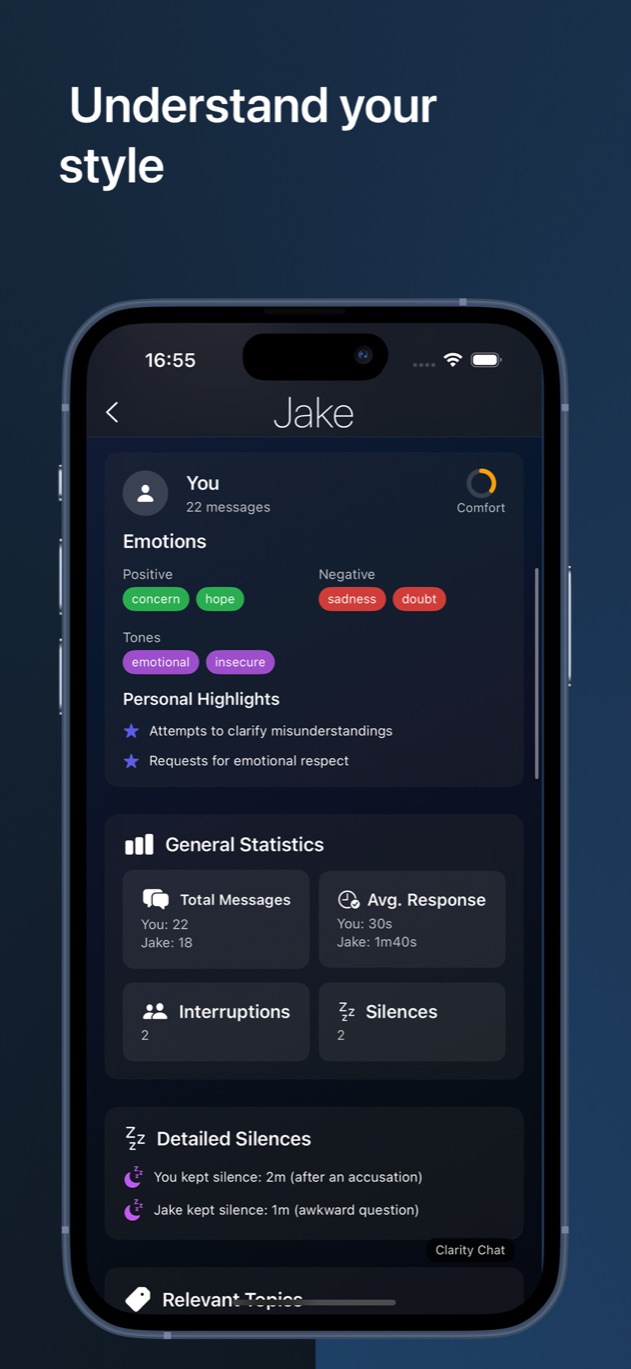
Read tone in clusters
Sarcasm, teasing and short replies are especially easy to misread without voice or shared history. Look for clusters of related signals: repeated dismissal plus topic changes plus refusal to answer a direct concern is more meaningful than one dry reply. Warmth also needs repetition. One enthusiastic text cannot outweigh weeks of one-sided contact.
Compare each person with their own normal style. Some people use few words with everyone. Others send long messages when anxious. A change from the person’s baseline often matters more than whether their style matches an internet rule about how interested people are supposed to text.
Look for repair, not perfect wording
Healthy communication can still be clumsy. The useful question is what happens after a misunderstanding. Does the person acknowledge your concern, explain without belittling you and make room for a different view? Do you offer the same room in return? Repair tells you more about a relationship than polished wording during an easy moment.
If a report highlights coldness, avoidance or emotional manipulation, read the examples underneath before accepting the label. Ask whether the examples form a repeated pattern and whether you feel able to raise the issue safely.
Turn the analysis into one real-world step
A useful analysis ends with a question, a boundary or a decision about your own behavior. You might ask, “When our plans changed, I felt dismissed. Can we talk about what happened?” You might decide to stop sending repeated follow-ups and wait for reciprocal effort. Keep the step small enough that you can observe the response.
If the conversation includes threats, coercion, stalking or fear, do not use a text analysis as a safety plan. Save relevant evidence somewhere safe and contact a trusted person, a qualified professional or a local relationship-abuse service.
Questions about this guide
Can one text message reveal how someone feels?
Usually not. One message may be important, but a reliable interpretation needs the surrounding conversation, the person’s normal style and what happened outside the chat.
How much of a conversation should I analyze?
Use enough consecutive messages to preserve the question, response and aftermath. In Clarity Chat that usually means two to four readable screenshots rather than unrelated highlights.