
AI relationship advice is most useful as a structured second opinion. It can summarize a chat, point to repeated wording and suggest questions you may have missed. It cannot know someone’s private thoughts, diagnose a relationship or decide whether you should stay. The safest approach is to inspect the examples, add missing context and choose your own next step.
Use AI relationship advice responsibly
- Decide on one question about the conversation before uploading anything.
- Choose a continuous sample and remove information that is not needed.
- Read the cited message examples before accepting any behavioral label.
- Add context the tool cannot see and consider at least one alternative explanation.
- Choose a reversible next step, such as a direct question, pause or boundary.
What AI can do with a relationship chat
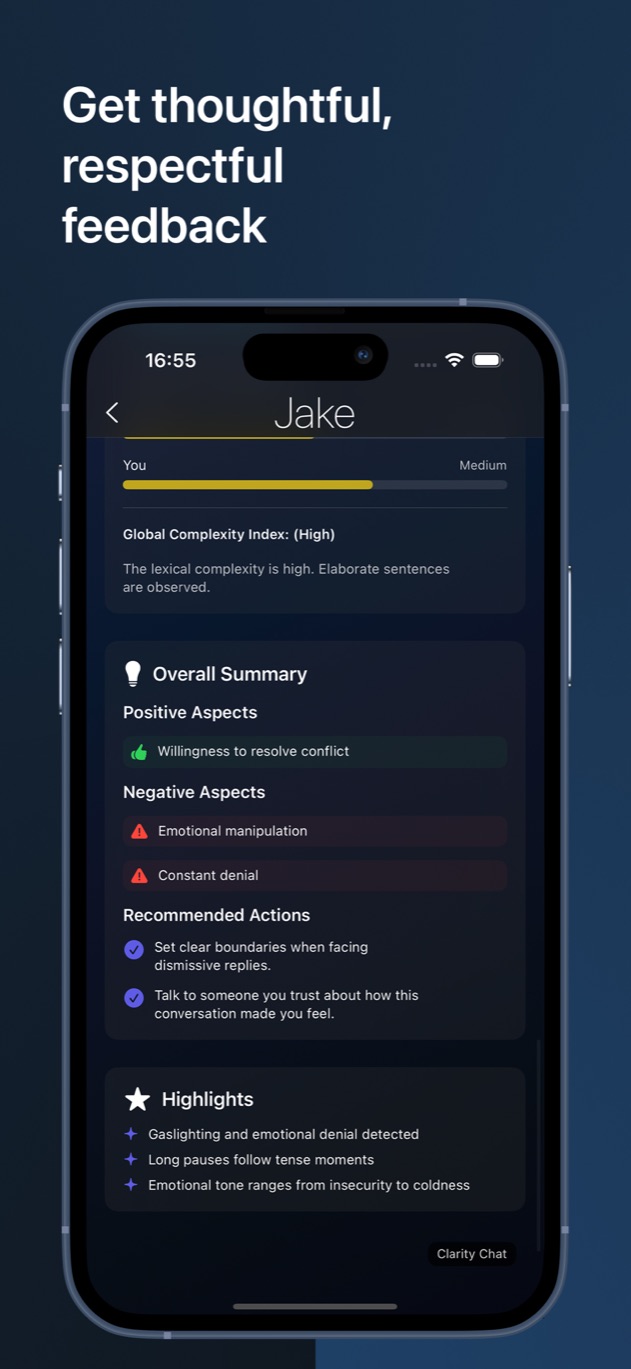
A conversation analyzer can sort a dense thread into categories that are easier to review. Clarity Chat looks at participant emotions, observed tone, message balance, response timing, quiet moments, recurring topics and specific excerpts. That structure can be valuable when you are too close to the exchange to see it clearly.
AI can also suggest wording for a follow-up or a boundary. The useful part is not that the suggestion is automatically right. It is that you get another draft to compare with your first impulse, especially if you were about to send a message while angry or frightened.
What it cannot know from screenshots
The model does not hear voice, see facial expression or know the agreements between you. It may not know that someone was at work, that an argument continued on a call, or that a phrase is an established joke. It also cannot observe a pattern that falls outside the selected screenshots.
Most importantly, it cannot read intent. A dismissive sentence may be careless, defensive or deliberately cruel. The impact on you matters, but the screenshot alone cannot establish the private reason behind it. Avoid results that claim certainty about love, attachment style, narcissism or future behavior.
Ask a question the evidence can answer
Broad questions such as “Does this person love me?” invite guesswork. Narrow questions produce better reflection: Does each person answer direct questions? Where did the tone change? Who attempted repair after the disagreement? Did response patterns change compared with earlier messages?
Choose screenshots that cover the question, not only the answer you fear. If you are reviewing a conflict, include the initial concern and the next attempt to resolve it. If you are reviewing interest, use more than one day so novelty or a busy afternoon does not dominate the report.
Check the evidence behind every label
Clarity Chat pairs behavior indicators with examples. Read those first. A label such as avoidance should be supported by repeated topic changes, unanswered concerns or withdrawal at similar moments. If the examples do not fit, disregard the label. Automated language analysis can make mistakes, especially with slang, irony and multilingual chats.
Also look for positive evidence. Mutual curiosity, willingness to clarify and repair after conflict may coexist with tension. A useful report should help you hold both parts of the conversation, rather than turning one person into a hero or villain.
Protect privacy and know when to ask a person
Clarity Chat’s published privacy policy says conversations are processed once and are not stored, shared, reused or sold for advertising. Screenshots still have to travel securely to the analysis service. Crop details that are irrelevant, and do not upload intimate or identifying material unless you have a lawful reason to do so.
For high-stakes questions, talk to a person who can understand the wider situation. A therapist can help with recurring relationship distress. A trusted friend can reality-check a confusing exchange. If there are threats, coercion or fear, contact a local abuse-support service or emergency service instead of relying on an app.
Questions about this guide
Is AI relationship advice accurate?
It can accurately quote and organize visible patterns, but interpretation is uncertain because screenshots omit context and private intent. Check the examples and treat the result as a hypothesis.
Should I follow an AI recommendation about ending a relationship?
No automated recommendation should make that decision for you. Consider your safety, lived experience, values and advice from qualified or trusted people who know the situation.