

Gaslighting is a repeated attempt to make someone doubt their memory, perception or judgment. In text messages it may appear as persistent denial of documented events, rewriting earlier statements, attacking your ability to remember or shifting the standard whenever you provide evidence. One disagreement, mistake or defensive reply is not enough to establish a gaslighting pattern.
Distinguish a pattern from an ordinary conflict
People remember conversations differently. They become defensive, use careless wording and sometimes deny something because they are embarrassed. Gaslighting is more systematic: the denials repeatedly pull you away from observable facts and toward distrust of your own mind.
Ask what happens when you clarify. A healthy but imperfect person may check the thread, admit uncertainty or correct themselves. A concerning pattern may include ridicule, absolute denial despite clear evidence, a new version of events each time, or punishment for raising the discrepancy.
Text patterns worth examining
No phrase proves gaslighting by itself. Look for combinations that recur and affect your ability to trust your experience. The surrounding behavior matters, including what happens in person and whether you feel free to disagree.
- They deny a statement that remains visible in the same thread.
- They insist you misunderstood every version while refusing to explain one consistent version.
- They shift from the event to attacks on your memory, stability or character.
- They move the standard after you answer the original accusation.
- They pressure you to keep the exchange secret or distance yourself from outside perspectives.
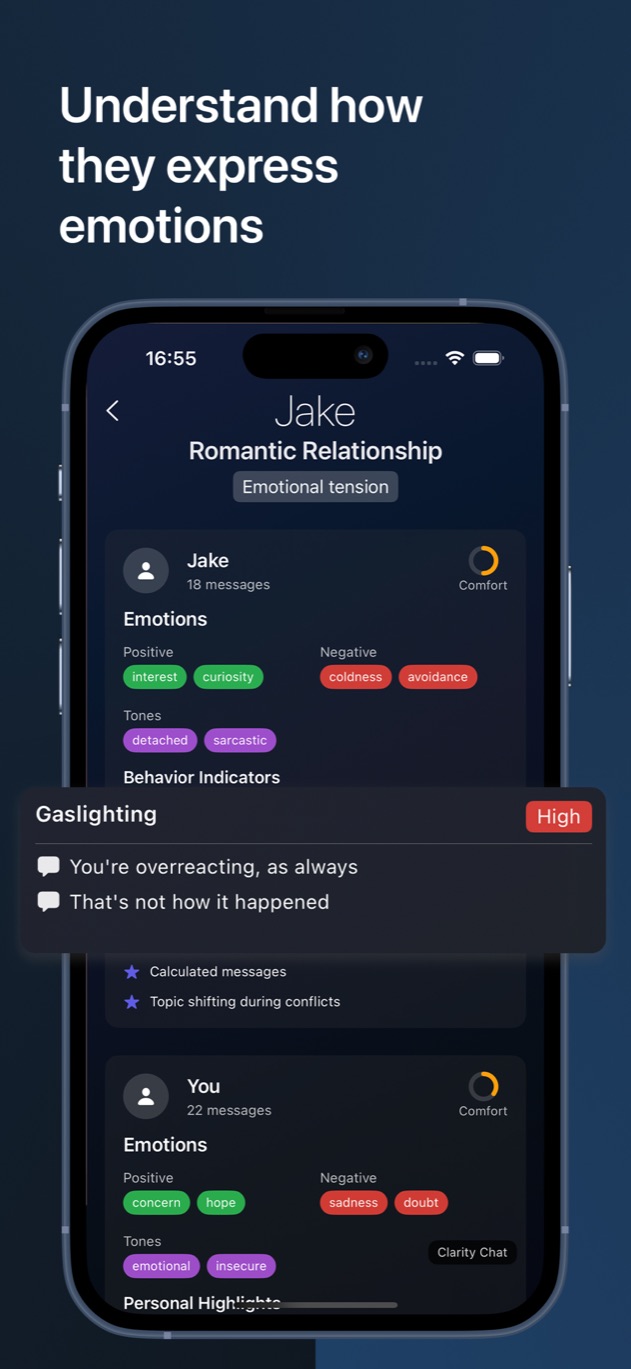
What an automated flag means
Clarity Chat may identify language that resembles denial, blame shifting or emotional manipulation and show examples from the selected screenshots. Read each example. Check extraction accuracy, sarcasm, quoted messages and whether the app assigned the right speaker.
An automated flag is not a diagnosis of a person or legal proof of abuse. A short sample can overstate a tense moment or miss a long pattern. Use the result to name what you want to review with a trusted person, therapist or advocate.
Keep a record without living inside the record
When it is safe, preserve important messages in a place the other person cannot access. Add dates and brief notes about what happened outside the chat. Do not spend hours trying to prove every detail to someone who repeatedly changes the terms of the discussion.
Share the pattern with a person you trust. An outside perspective can help you distinguish a mutual misunderstanding from a recurring effort to destabilize you. If a partner monitors your phone, use a safer device before saving evidence or contacting support.
Get support when fear or control is present
Threats, stalking, coercive control and isolation deserve human support. If you are in immediate danger, contact local emergency services. In the United States, the National Domestic Violence Hotline offers phone, chat and text support; elsewhere, use a trusted local service.
You do not need an app to certify that an interaction hurts or frightens you before asking for help. Clarity Chat can help organize words on a screen. Your safety plan should come from people and services equipped to understand the full situation.
Responsible sources and support
Questions about this guide
Is denying one text message gaslighting?
Not necessarily. Gaslighting describes a repeated pattern that undermines your trust in your perception; one denial may be a mistake, defensiveness or a different memory.
Can screenshots prove emotional abuse?
Screenshots can document part of a pattern, but they rarely contain the entire relationship context. A qualified advocate, clinician or legal professional can help you assess serious concerns.